 EN
EN


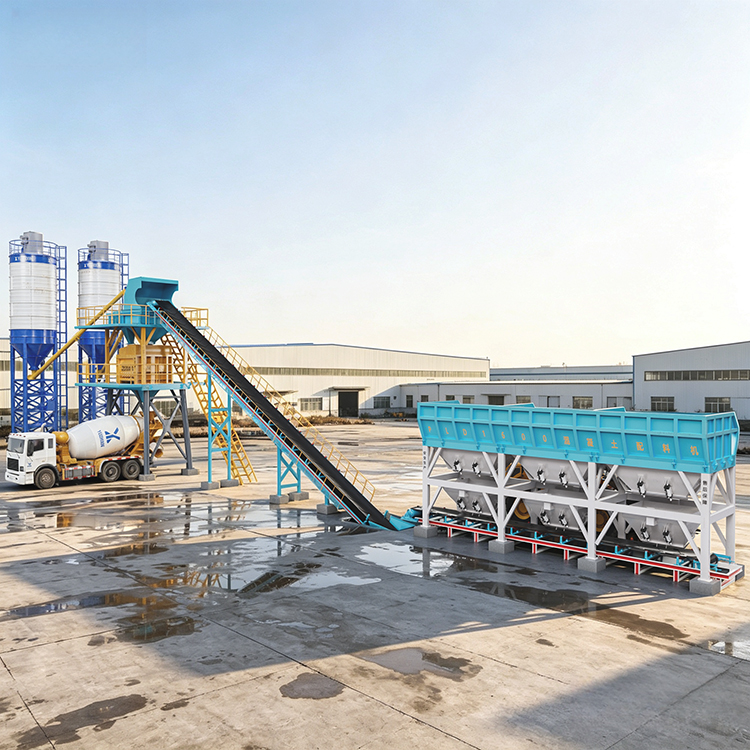
When to Invest in a Stationary Concrete Batching Plant
A precast manufacturer in South America operated three mobile plants at separate sites for two years before consolidating into a single stationary concrete batching plant with twin 2.0 m³ mixers serving a central yard. The mobile plants had cost 18 per cubic meter in combined operating expense — fuel, relocation labor, maintenance, and downtime. The stationary plant, once commissioned, delivered concrete at 11 per cubic meter including amortized capital cost. The business recovered its $320,000 stationary plant investment within 14 months through reduced operating costs alone.
A stationary concrete batching plant is a permanent production asset. The decision to invest turns on whether total concrete volume, project duration, and mix complexity justify the higher upfront capital against substantially lower per-unit operating costs.
When Volume Justifies a Stationary Plant
Calculating the Break-Even Concrete Volume
The financial analysis compares two scenarios. Scenario A: a mobile plant purchased or leased and operated at a variable cost of 15-22 per cubic meter when fuel, relocation, and reduced productivity from frequent setup are included. Scenario B: a **stationary concrete batching plant** with annualized capital cost of 30,000-60,000 plus operating costs of $8-12 per cubic meter from lower labor, energy, and maintenance per unit produced.
The break-even calculation is straightforward. With a 45,000 annualized capital cost and 6 per cubic meter operating cost advantage, a stationary plant must produce approximately 7,500 cubic meters annually to match mobile plant economics. Below this volume, mobile or modular plants avoid the fixed cost burden. Above 15,000 cubic meters annually, the stationary plant's operating efficiency widens the gap decisively.
Project Duration as the Deciding Factor
A high-rise construction project consuming 30,000 cubic meters over 24 months justifies a dedicated stationary plant on-site despite the finite project duration — the concrete volume within the project window achieves payback. A road project consuming 50,000 cubic meters over 36 months but spread across a 120-kilometer alignment does not — the linear geography makes a single stationary plant impractical as haul distances grow beyond economical limits.
The practical rule: if a project or permanent facility will consume over 10,000 cubic meters within a 30-kilometer radius over 12 months or longer, a stationary concrete batching plant deserves serious evaluation. Below these thresholds, mobile, modular, or commercial ready-mix supply generally offers better financial outcomes.
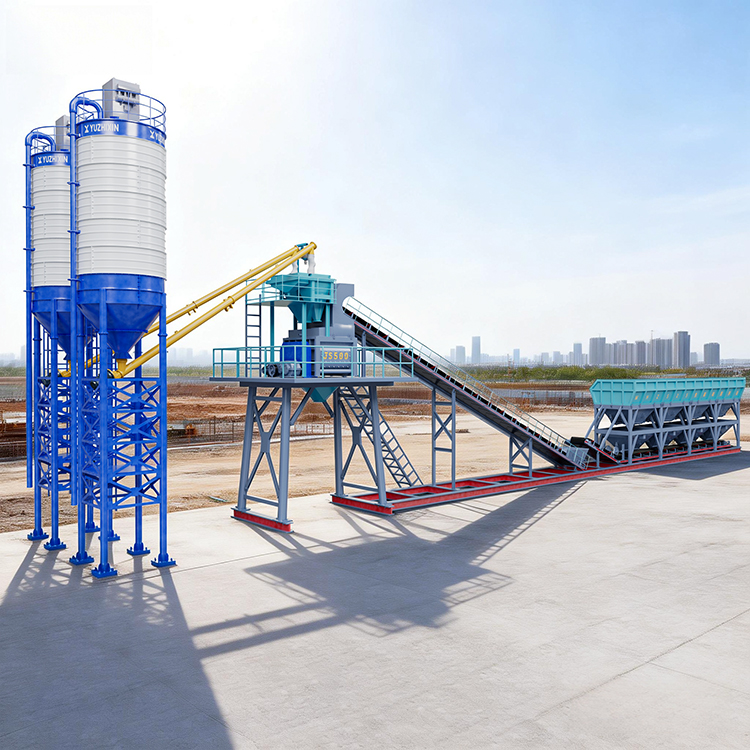
Stationary vs Mobile Plant Economics
Capital Cost and Infrastructure
A 60 m³/h stationary concrete batching plant with twin-shaft mixer, four-compartment aggregate bins, two 100-tonne cement silos, and full automation typically costs 180,000-350,000 depending on configuration and market. Foundation work — reinforced concrete pads for the mixer tower, bin support structure, and silos — adds 30,000-60,000. Electrical infrastructure, water supply, and compressed air systems add another 15,000-30,000. Total installed cost: 225,000-440,000.
A mobile plant of equivalent 60 m³/h output costs 120,000-200,000 with minimal foundation requirements — compacted gravel pads and screw anchors rather than reinforced concrete. The mobile plant saves 100,000-200,000 upfront but typically consumes 30-50% more per cubic meter in operating costs over its service life due to more frequent maintenance, higher energy consumption from less efficient layout, and productivity losses during relocation.
Per-Cubic-Meter Cost Over Plant Life
Over a 10-15 year service life producing 15,000-30,000 cubic meters annually, the per-cubic-meter capital component of a stationary concrete batching plant falls to 1.50-4.00. Adding operating costs of 8-12 per cubic meter yields a total production cost of 10-16 per cubic meter. Commercial ready-mix concrete in most markets costs 60-100 per cubic meter delivered, making on-site stationary production the clear cost leader when volumes justify the upfront investment.
Operational Advantages Unique to Stationary Plants
Stationary plants permanently plumbed to power, water, and compressed air infrastructure eliminate the daily setup and teardown that erodes mobile plant productivity. The plant structure accommodates larger aggregate storage — 200-400 tonnes in elevated bins versus 30-80 tonnes on trailer-mounted units — reducing the loader movements and delivery truck frequency that add cost per batch.
For precast, block-making, and infrastructure applications requiring tight mix consistency, a stationary concrete batching plant with automated moisture compensation, temperature-controlled mixing water, and programmable mix sequences delivers batch-to-batch uniformity that mobile plants struggle to match.
Frequently Asked Questions
What concrete volume justifies a stationary batching plant?
Approximately 7,500 cubic meters annually represents the minimum break-even volume at typical cost differentials. Above 15,000 cubic meters annually, stationary plant economics decisively favor the investment. Below 5,000 cubic meters, mobile or modular plants avoid the fixed cost burden that erodes returns at low utilization rates.
How long does it take to install a stationary concrete batching plant?
Foundation and civil works require two to four weeks. Mechanical erection of the mixer tower, bins, and conveyors takes three to five weeks. Electrical, control system, and commissioning add two to three weeks. Total installation from ground-breaking to first production: 8-14 weeks depending on site conditions and plant complexity.
What are the main cost components of a stationary concrete batching plant investment?
Equipment cost (60-70% of total): mixer, bins, silos, conveyors, control system. Civil works (15-20%): foundations, retaining walls, drainage. Utilities (5-10%): electrical connection, water supply, compressed air. Installation and commissioning (10-15%): cranage, mechanical erection, electrical wiring, PLC programming, and trial batches.
Does a stationary plant produce better quality concrete than a mobile plant?
Stationary plants with automated moisture probes, temperature-controlled water, and programmed mix sequences achieve tighter batch-to-batch consistency — typically ±15 mm slump variation versus ±25-35 mm for mobile plants. The quality difference matters most for high-strength, precast, and infrastructure concrete where specification compliance windows are narrow.
What site requirements must be met for a stationary concrete batching plant?
A level site of 3,000-5,000 square meters with load-bearing soil capacity of 150 kPa or higher for foundation design. Three-phase power at 380-480V with adequate capacity for the mixer motors (typically 2×37 kW or 2×55 kW for twin-shaft configurations). Reliable water supply at 10-20 cubic meters per hour. All-weather access for aggregate delivery trucks and ready-mix truck circulation.
When does a mobile plant make more sense than a stationary investment?
Mobile plants suit projects producing under 10,000 cubic meters within 12 months, linear construction such as road and pipeline projects where work fronts move continuously, and operations requiring plant relocation within days rather than weeks. The lower capital commitment also suits contractors entering new markets who want to preserve the option to redeploy assets.