 EN
EN


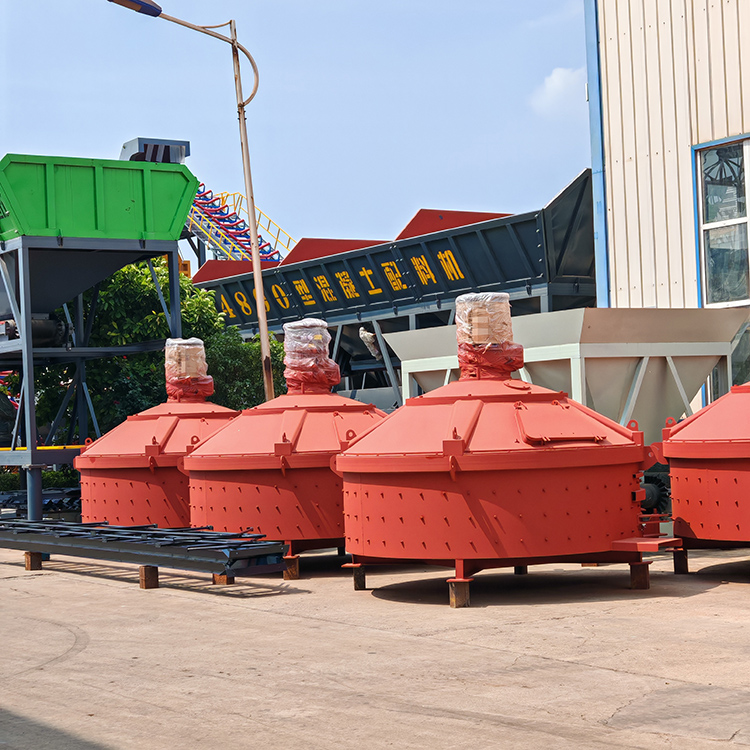
Does Planetary Concrete Mixer Produce Stronger Concrete?
A precast factory producing 80 MPa bridge segments switched from a twin-shaft to a planetary concrete mixer after six months of inconsistent compressive strength results — cylinders from the same batch varying by up to 8 MPa. Investigation revealed that the twin-shaft mixer's blending action was not fully dispersing the 8% silica fume content through the low-water-content mix, creating localized weak zones where agglomerated silica fume particles acted as stress concentrators rather than pozzolanic reinforcement. The planetary mixer, with its multiple rotating tools creating intersecting shear zones, reduced strength variation to ±2 MPa within six weeks of commissioning.
A planetary concrete mixer does not magically produce stronger concrete. It produces more thoroughly mixed concrete — and for high-strength, high-performance, and ultra-high-performance mixes, mixing thoroughness directly determines compressive strength.
What Makes a Mixer Suitable for High-Strength Concrete
The Role of Cement Paste Dispersion
High-strength concrete — defined by ACI as 55 MPa or higher — uses cement contents of 450-600 kg/m³ with water-cement ratios below 0.35. At these low water contents, cement paste is viscous and resists flow. A mixer that merely tumbles or shears the paste in one direction leaves cement grain agglomerations intact — clusters of 50-100 cement particles that hydrate on their exterior surfaces while the interior particles remain unhydrated, functioning as inert filler rather than reactive binder.
A planetary concrete mixer generates mixing action in multiple directions simultaneously. The mixing stars rotate on their own axes while orbiting around the central shaft, and the mixing pan rotates in the opposite direction — typically at 5-8 rpm for the stars and 2-4 rpm for the pan in counter-rotation. This multi-axis shear breaks cement agglomerations that single-direction mixing leaves intact, exposing more cement surface area to water and increasing the effective cement utilization for strength development.
Micro-Silica and Ultra-Fine Particle Distribution
Silica fume particles measure 0.1-0.3 microns — 100 times smaller than cement grains. Achieving uniform dispersion of these sub-micron particles in a low-water paste requires mixing energy far beyond what normal concrete demands. Undispersed silica fume agglomerates create two problems: they fail to contribute pozzolanic reaction where they clump, and they create porosity at the agglomerate-paste interface that reduces density and strength.
Testing by the Precast/Prestressed Concrete Institute demonstrates that planetary concrete mixer designs achieve silica fume dispersion measurable through electrical resistivity testing — a proxy for pore structure refinement — that is 15-25% better than single-shaft mixers and 8-12% better than twin-shaft configurations in mixes containing over 5% silica fume by cement weight. For mixes below 50 MPa without silica fume, these dispersion differences are not practically significant.
How Planetary Mixers Achieve Intensive Mixing
The mixing mechanism in a planetary concrete mixer combines three simultaneous motions. The mixing stars (typically one to three units, each with two to four arms) rotate on their own axes at high speed — 40-80 rpm for the star rotation. Simultaneously, the star assembly orbits the mixer center at 20-40 rpm, and the pan rotates in the opposite direction at 5-10 rpm. A single particle in the mix experiences shear from multiple directions within each revolution, compared to the bidirectional but planar shear generated between counter-rotating shafts in a twin-shaft mixer.
This multi-directional shear is particularly effective for stiff consistencies — concrete with slumps below 50 mm, typical of precast and high-strength applications. The planetary concrete mixer maintains mixing intensity as mix stiffness increases, whereas twin-shaft mixer effectiveness drops when the concrete does not flow freely between the shafts.
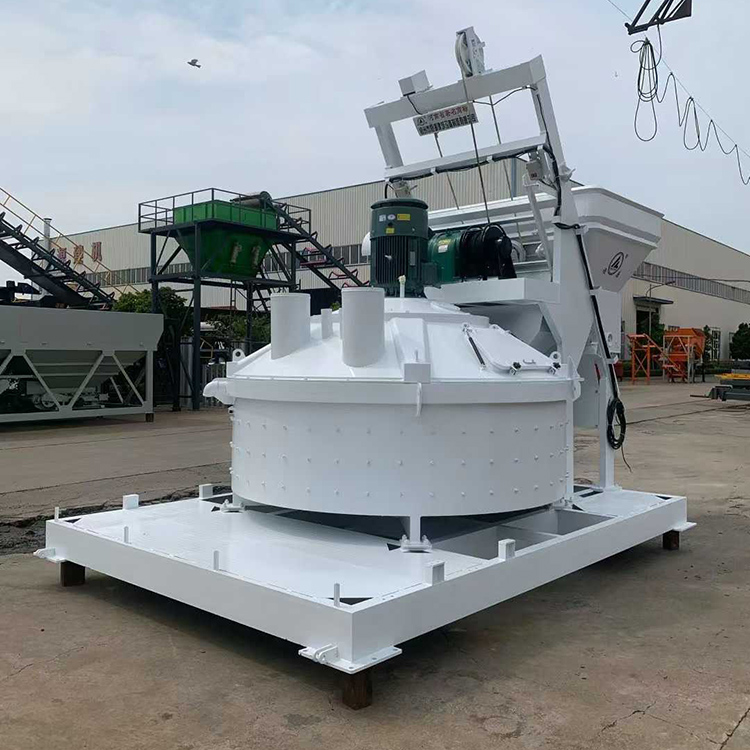
When Mixer Type Actually Matters
For standard ready-mix concrete of 20-40 MPa with slumps of 80-150 mm, the mixing mechanism — planetary versus twin-shaft — produces negligible strength differences. Proper batching, accurate water dosing, and adequate mixing time dominate the result. For high-strength concrete above 60 MPa, low-slump precast concrete, and any mix containing over 5% silica fume or ultra-fine supplementary cementitious materials, the planetary mixer's multi-axis shear provides measurable improvements in strength consistency and silica fume utilization.
Frequently Asked Questions
Does a planetary concrete mixer produce higher compressive strength than twin-shaft?
For concrete above 60 MPa containing silica fume or ultra-fine materials, planetary mixers produce 5-10% higher average compressive strength and 50-70% lower strength variation between samples from the same batch. For standard ready-mix grades below 40 MPa without silica fume, the mixer type has no measurable effect on strength — batching accuracy and water control are the dominant factors.
Why is a planetary concrete mixer better for high-strength concrete?
The multi-axis mixing action — stars rotating on their axes while orbiting the center with counter-rotating pan — generates shear from multiple directions simultaneously. This breaks cement agglomerations and disperses sub-micron silica fume particles more effectively than the bidirectional planar shear of twin-shaft mixers, which is critical at water-cement ratios below 0.35 where paste viscosity resists conventional mixing.
What is the mixing mechanism of a planetary concrete mixer?
Three simultaneous motions: mixing stars rotate at 40-80 rpm on their own axes, the star assembly orbits the mixer center at 20-40 rpm, and the pan rotates in the opposite direction at 5-10 rpm. Each particle experiences multi-directional shear within every revolution, providing the intensive mixing action needed for stiff, low-water-content high-performance concrete.
When is a planetary mixer worth the investment over twin-shaft?
Precast concrete production, high-strength concrete above 60 MPa, ultra-high-performance concrete (UHPC) above 120 MPa, and any application using more than 5% silica fume justify the planetary mixer investment. For standard ready-mix production, twin-shaft mixers offer higher throughput at lower cost with adequate mixing quality for conventional grades.
How does mixing time compare between planetary and twin-shaft mixers?
Planetary mixers typically require 45-70 seconds total cycle time for high-strength mixes versus 35-50 seconds for twin-shaft mixers on standard grades. The longer cycle time in planetary mixers reflects the more intensive mixing action needed to achieve dispersion quality, not lower efficiency — for a given high-strength mix, a planetary mixer may require 60 seconds where a twin-shaft would need 90-120 seconds to achieve equivalent dispersion.
What maintenance differences exist between planetary and twin-shaft concrete mixers?
Planetary mixers have more moving parts — multiple star drive shafts, pan rotation drive, and complex seal arrangements at each penetration point — resulting in 20-30% higher annual maintenance cost than equivalent-capacity twin-shaft mixers. The trade-off is justified when the mixer's superior dispersion enables high-strength concrete production that twin-shaft mixers cannot achieve reliably.